Hague Convention vs. Embassy Legalization: Navigating Global Authentication
Navigating Hague Convention vs. Embassy Legalization is the most critical hurdle for individuals and corporations transmitting legal documents across international borders. Whether you are expanding business operations into Dubai, authenticating vital records for European dual citizenship, or executing power of attorney for foreign real estate transactions, executing the wrong legalization workflow will result in immediate rejection by foreign government authorities. This exhaustive operational guide details the legal mechanics of Hague Convention vs. Embassy Legalization, outlining single-step state Apostilles, multi-tiered diplomatic authentication chains through Washington D.C., country-specific consular mandates, document pre-reviews via secure unique upload links, and mobile courier dispatch across Los Angeles and Ventura Counties.
International Legalization Desk
Serving Los Angeles & Ventura Counties
- Complete Handling: Mobile notary pickup to State/Federal filing
- Hague & Non-Hague: Direct filings for all 190+ countries
- Free Document Audit: Pre-review via encrypted secure link
In This International Authentication Guide:
1. The 1961 Hague Apostille Treaty Mechanics
Prior to 1961, authenticating legal records for international use required a cumbersome series of certifications through local courts, state departments, national foreign ministries, and foreign embassies. To eliminate these diplomatic bottlenecks, major sovereign nations drafted the Hague Convention of 5 October 1961 Abolishing the Requirement of Legalisation for Foreign Public Documents.
Under the treaty, if both the originating country (e.g., the United States) and the receiving country (e.g., Mexico, Spain, Italy, France, Colombia, Philippines, United Kingdom) are member nations, a single standardized certificate called an Apostille satisfies all legal authentication requirements. You can verify whether your destination country is an active signatory by reviewing the official HCCH Member States Register.
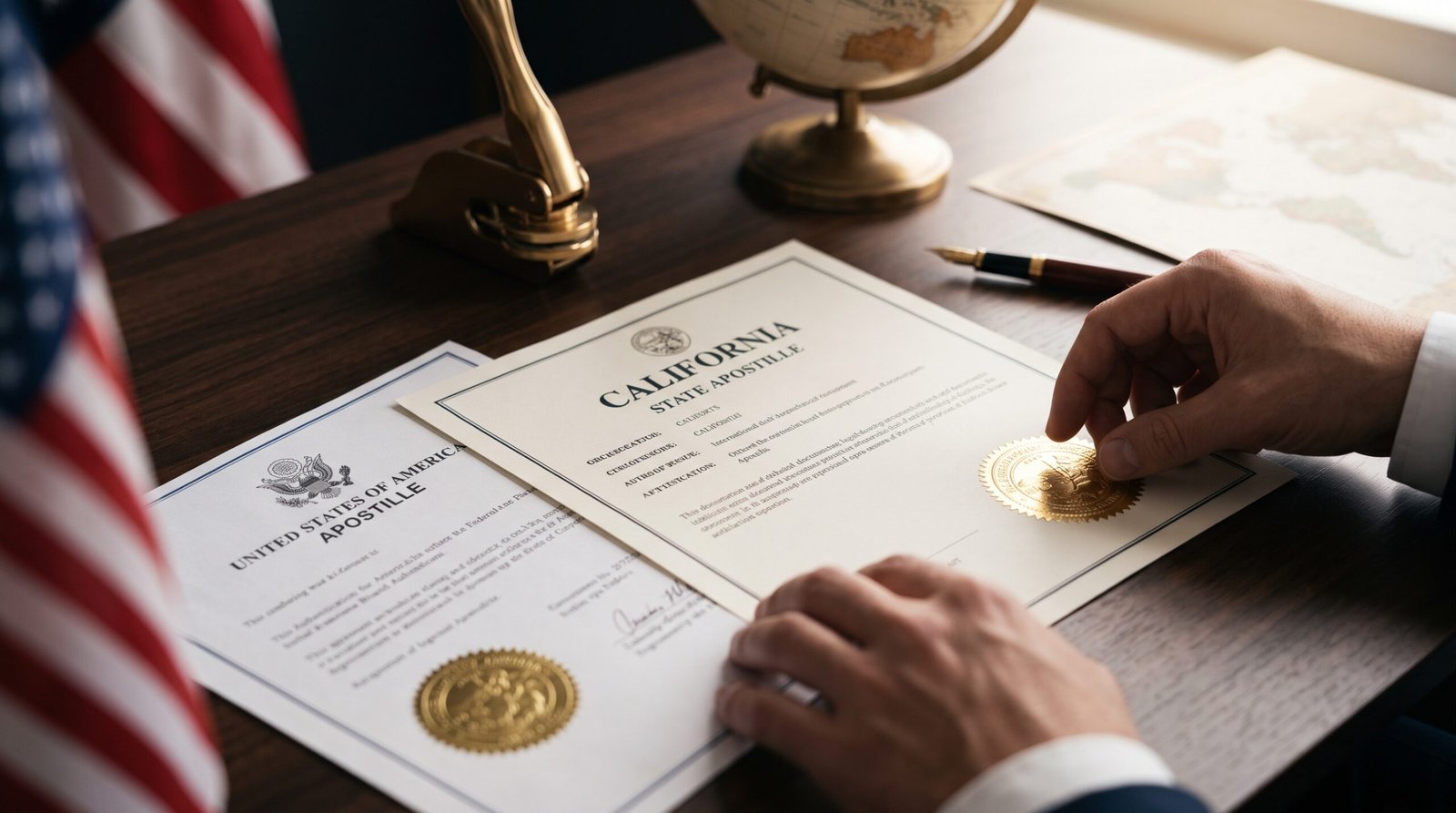
An Apostille verifies the authenticity of the signature, the capacity in which the person signing the document acted, and, where appropriate, the identity of the seal or stamp which it bears. Once attached by an official Competent Authority (such as the California Secretary of State), foreign authorities in all 120+ member nations are legally bound to recognize the document without further diplomatic certification.
State vs. Federal Competent Authorities
A critical distinction when navigating Hague Convention vs. Embassy Legalization is identifying whether your document requires state-level or federal-level Apostille processing:
2. Embassy Legalization for Non-Hague Nations
If your destination country has not signed or ratified the 1961 Hague Apostille Treaty, an Apostille certificate cannot be issued or accepted. Instead, your documents must proceed through the traditional, multi-stage Chain Legalization process.
The Four Sequential Steps of Embassy Legalization
3. Side-by-Side Architectural Comparison
Understanding the legal differences between these two pathways ensures accurate budget and timeline expectations for international transactions:
| Evaluation Parameter | Hague Apostille Convention Nations | Non-Hague Embassy Legalization Nations |
|---|---|---|
| Legal Governance | Multilateral 1961 Hague Apostille Treaty | Individual bilateral diplomatic & consular regulations |
| Primary Certificate Issued | Apostille Certificate (Single Sheet Attached) | State Auth + Federal Seal + Embassy Stamp Ribbon |
| Number of Agency Steps | 1 Agency Step (State Secretary or Federal Dept of State) | 3 to 4 Agency Steps (State $\rightarrow$ Federal D.C. $\rightarrow$ Embassy $\rightarrow$ MOFA) |
| U.S. Dept. of State (D.C.) Required? | Only for federal records (e.g., FBI checks, FDA) | Mandatory for all state documents prior to Embassy filing |
| In-Country Legalization Required? | No. Valid immediately upon arrival in member country | Often requires final Ministry of Foreign Affairs (MOFA) stamp |
| Turnaround Timeline | Fast (Same-Day / Next-Day Hand-Carried) | Multi-Week (Subject to D.C. and Embassy queues) |
4. Specific Country Protocols & Legalization Mandates
Diplomatic requirements vary significantly depending on the receiving sovereign state. Below are operational guidelines for non-Hague nations frequently processed for Southern California clients:
United Arab Emirates (UAE)
Non-HagueRequires state authentication, U.S. Department of State federal seal in Washington D.C., and final UAE Embassy legalization. Educational degrees require official university transcripts in sealed envelopes. Upon arrival in Dubai or Abu Dhabi, documents must receive final stamp certification from the UAE Ministry of Foreign Affairs (MOFA).
Qatar & Kuwait
Non-HagueBoth nations enforce strict commercial invoice and certificate of origin rules. Commercial documents must often be authenticated by an approved Arab-American Chamber of Commerce prior to federal Department of State and Qatar/Kuwait Embassy submission.
Vietnam
Non-HagueRequires full chain legalization through the Embassy of Vietnam in Washington D.C. or the Consulate General of Vietnam in San Francisco. Vital records and work permit background checks must feature certified Vietnamese translations performed by authorized diplomatic agencies.
Saudi Arabia & Taiwan
SpecializedNote: Mainland China joined the Hague Apostille Convention in late 2023, streamlining filings to single-step Apostilles. However, Taiwan (TECO) and Saudi Arabia enforce specialized consular verification forms and require local commercial notary attestations prior to submission.
5. Vital Records vs. Corporate Document Requirements
Before submitting documents for an Apostille or Embassy Legalization, each document type must satisfy specific statutory preparation rules:
California Vital Records (Birth, Death, Marriage)
Vital statistics records cannot be notarized by a notary public. They must be certified copies issued directly by the County Recorder or the California Department of Public Health (CDPH) in Sacramento.
Business & Corporate Documentation
Corporate agreements, Powers of Attorney, Board Resolutions, and Operating Agreements must be executed before a California Notary Public.
6. The Top 4 Rejection Traps in International Legalization
7. Pre-Review Paperwork via Our Secure Document Portal
Unsure if your document requires a Hague Apostille or multi-step Embassy Legalization? Don't risk submitting improper notarizations or getting rejected by state officials or foreign embassies! We provide a free document pre-review service to audit your paperwork before filing.
How the Pre-Review Process Works:
- Call to Request Your Link: Call our main office at (818) 264-1496. Our team will verify your service request and immediately send an encrypted, unique upload link to your phone or email.
- Upload Your Paperwork: Click your personalized link to upload clear photos or PDFs of your vital certificates, notarized powers of attorney, or corporate records.
- Expert Legalization Audit: Our document specialists review your notary acknowledgement language, county clerk signatures, and destination rules free of charge.
- Expedited Filing & Mobile Dispatch: Once verified, we schedule mobile notary pickup or hand-carry your documents directly to the California Secretary of State for processing.
8. On-Demand Mobile Notary & Hand-Carried Courier Filings
ALL LA NOTARY & LIVESCAN provides a seamless end-to-end authentication solution across Southern California. You never have to leave your home or navigate state government offices:
Fast Mobile Apostille & Embassy Legalization Service
Need an immediate Apostille or Embassy Legalization for documents bound for Mexico, UAE, Spain, Philippines, Qatar, or anywhere globally? Call us at (818) 264-1496 to request your unique secure portal link or book mobile notary dispatch across Los Angeles and Ventura Counties.
Important Regulatory Notice & Legal Disclaimer
ALL LA NOTARY & LIVESCAN is not an attorney or law firm and does not provide legal advice. We provide private document authentication, mobile notary public, and filing courier services under California statutory guidelines. International authentication rules, embassy fees, and consular regulations are subject to change based on foreign government mandates.
Agoura Hills • Bel Air • Beverly Hills • Brentwood • Burbank • Calabasas • Chatsworth • Encino • Granada Hills • Hidden Hills • Malibu • Northridge • Pacific Palisades • Pasadena • Porter Ranch • San Fernando Valley • Santa Clarita • Santa Monica • Sherman Oaks • Stevenson Ranch • Studio City • Tarzana • Toluca Lake • Topanga • Valencia • West Hills • Westlake Village • Westwood • Woodland Hills
Bell Canyon • Camarillo • Dos Vientos Ranch • Lake Sherwood • Moorpark • Oak Park • Oxnard • Santa Rosa Valley • Simi Valley • Thousand Oaks • Ventura
Need on-site Apostille document pickup, mobile notarization, or Live Scan services? Call or text (818) 264-1496 to schedule your appointment!
Ready to Authenticate Your International Documents?
Call (818) 264-1496 to request a unique upload link for document pre-review or book rapid 24/7 mobile notary dispatch across Los Angeles and Ventura Counties.